
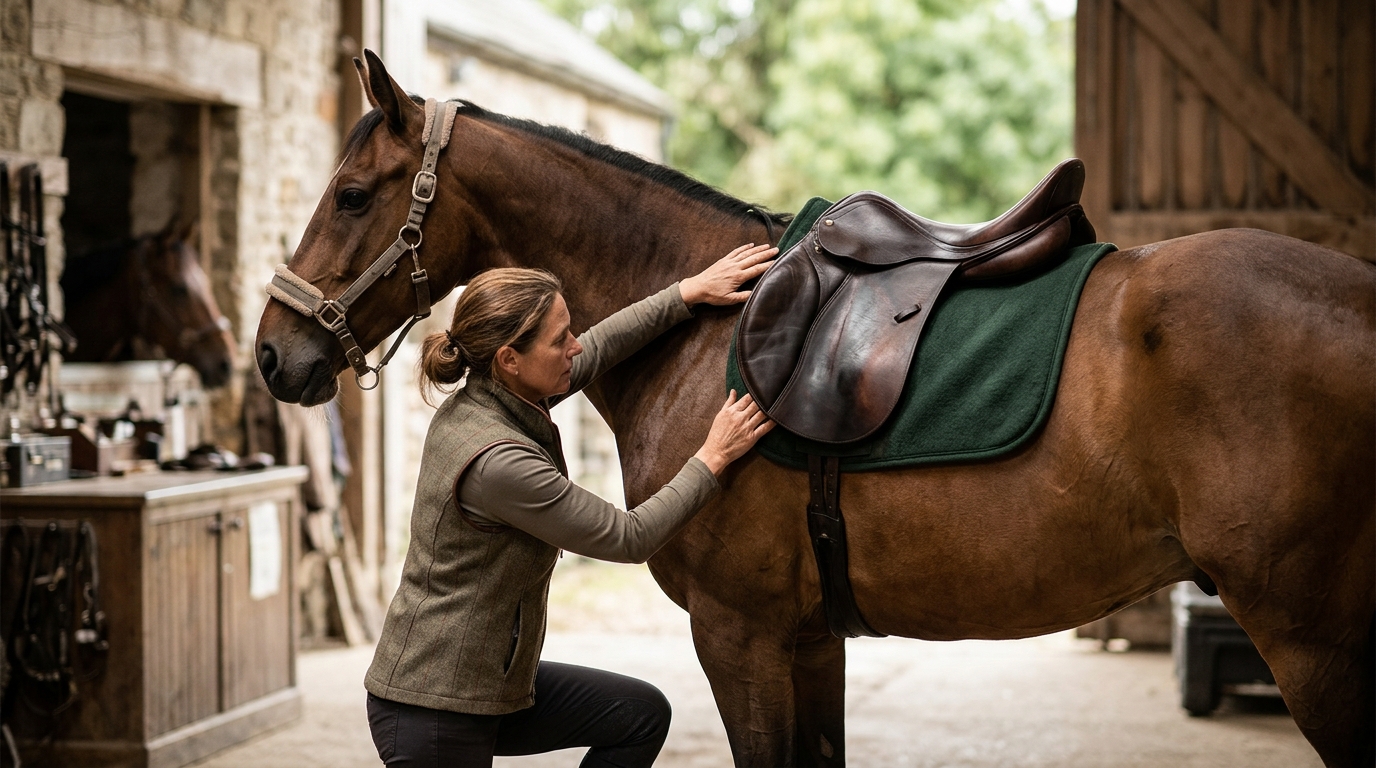
What Does Proper Saddle Fitting Actually Look Like for Different Horse Body Types?
Proper saddle fitting for different horse body types means matching the saddle tree's width, length, and angle to the specific conformation of the horse's back, shoulders, and withers. This ensures the weight is distributed evenly across the saddle support area without pinching the spine or restricting shoulder movement. Horse Sport emphasizes that a saddle must fit both the horse's changing musculature and the rider's balance to prevent long-term damage.
Anatomy and the Saddle Support Area
The saddle support area is the specific region of the horse's back, located between the base of the withers and the last rib, that is anatomically designed to bear the weight of the saddle and rider. Most horses have a saddle support area that is approximately 4 inches wide and 16 inches long on each side of the spinal column. The tree of the saddle is designed so that the front and rear fields each carry 30% of the weight, while the middle part carries 40%. This distribution is critical because the spine and ligaments cannot tolerate prolonged compression.
If a saddle is too long, it will sit on the shoulder or the lumbar area, which are not designed for static weight bearing. This can lead to muscle atrophy, a dip in front of the sacroiliac joint, and restricted back movement. Understanding this anatomy is the first step in recognizing why a one-size-fits-all approach to saddle fitting is ineffective for different body types.
Fitting for Different Body Types
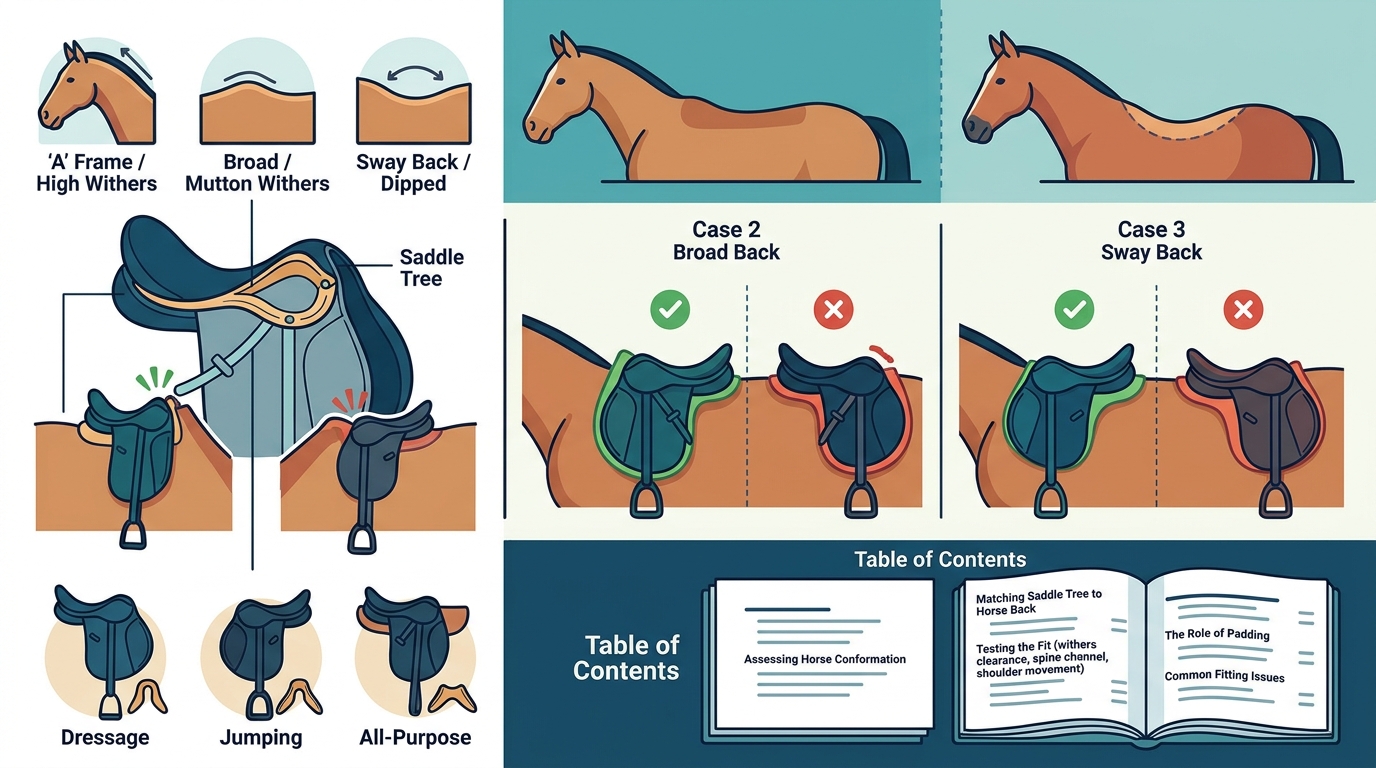
Horses vary significantly in conformation, and a saddle that fits a wide, round-backed horse will likely pinch the withers of a narrow, angular horse. For a horse with a high wither, the gullet channel must be deep enough to clear the bone without touching it. If the gullet is too narrow, it will impinge on the spinal processes, causing pain and potentially leading to kissing spine, a condition where the dorsal spinous processes touch or rub against each other.
For horses with a long back, the saddle tree must be long enough to bridge the withers and distribute weight without sitting on the shoulder. Conversely, a saddle that is too long for a short-backed horse will slide forward during motion, placing pressure on the shoulder and restricting the horse's ability to engage its hindquarters. The angle of the tree points must also be parallel to the angle of the shoulders, not the withers, to allow the shoulder and tree point to glide past each other easily.
Signs of a Poor Fit
Behavioral changes are often the first indicator of a poorly fitted saddle. In a recent study of 1,326 horses in the UK, 91% of owners reported that their mounts exhibited some sort of regular behavior problem under saddle. The most prevalent problem was shying (50%), followed by walking off while being mounted (46%), and leaning on the bit (45%). These behaviors may be attributed to poor riding practices, but they can also be direct results of saddle pressure.
Physical signs of a poor fit include white patches of hair on the withers, which indicate pressure points. A 'hunter's bump' is another sign, representing damage to the sacroiliac joint. Horses may also scoot down and away from pain while being ridden or develop a tight barrel as their abdominal muscles tense up. If you notice these signs, it is essential to have the saddle evaluated by a professional.
The Rider's Role in Fit
Saddle fitting is not just about the horse; it must also accommodate the rider's body type and balance. The twist of the saddle, which is the part of the tree felt between the rider's upper inner thighs, is crucial for rider comfort. A wide twist under a short rider can make them feel as if they are sitting on a barrel, unable to keep their leg on the horse. For women, a narrow, upside-down U-shaped twist is often better suited to their pelvic structure.
Rider balance also affects saddle fit. If a rider is falling backward, the saddle may be too high in the pommel and too low in the cantle, causing pressure on the horse's back. If the rider is leaning forward, the saddle may be too low in the front, pinching the horse's shoulder. A well-balanced saddle allows the rider to sit over the center of gravity, distributing their weight evenly and allowing the horse to move freely.
Maintenance and Re-evaluation
Horses change conformation through training, health, conditioning, age, and nutrition. A saddle that fits perfectly today may not fit in six months. It is recommended to have the saddle rechecked annually, especially if the horse is in active training. Muscle mass can change significantly in a short period, and a saddle that was previously comfortable may now be causing pressure points.
Regular maintenance of the saddle itself is also important. Flocking can shift, leather can stretch, and the tree can twist due to uneven musculature. These changes can alter the fit of the saddle, even if the horse's conformation has not changed. By regularly evaluating the fit, you can prevent long-term damage to both the horse and the rider.
Key Takeaways
- The saddle support area is the only part of the horse's back designed to bear weight, and the tree must be sized to fit this area.
- Different horse body types require different saddle tree widths, lengths, and angles to ensure proper fit.
- Behavioral changes like shying or leaning on the bit can be signs of a poorly fitted saddle.
- Physical signs such as white hair patches or a 'hunter's bump' indicate pressure points and potential damage.
- The rider's body type and balance must also be considered when fitting a saddle.
- Horses change conformation over time, so the saddle fit should be re-evaluated annually.
Frequently Asked Questions
How often should I have my saddle fit checked?
It is recommended to have your saddle fit checked annually, or more frequently if your horse is in active training or has undergone significant changes in weight or muscle mass.
What is the saddle support area?
The saddle support area is the region of the horse's back between the base of the withers and the last rib, which is anatomically designed to bear the weight of the saddle and rider.
Can a saddle fit both the horse and the rider?
Yes, a properly fitted saddle must accommodate both the horse's conformation and the rider's body type and balance to ensure comfort and prevent injury.
What are the signs of a poorly fitted saddle?
Signs include behavioral changes like shying or leaning on the bit, physical signs like white hair patches or a 'hunter's bump', and the horse scooting away from the saddle.
Does the saddle tree need to be adjusted as the horse ages?
Yes, as horses age, their conformation can change due to muscle loss or gain, and the saddle tree may need to be adjusted to maintain a proper fit.
What is the twist of a saddle?
The twist of a saddle is the part of the tree felt between the rider's upper inner thighs, which is crucial for rider comfort and balance.