

Understanding horse behavior is one of the most important skills any new equestrian can develop. Whether you just bought your first horse or you are taking weekly riding lessons, learning why horses act the way they do will keep you safer and deepen your bond with these remarkable animals. Horse behavior is the study of how horses communicate, react to stimuli, and interact with humans and other horses. This guide walks you through exactly where to find trustworthy, beginner-friendly articles on equine behavior and how to get the most from them.
Why Understanding Horse Behavior Matters for Beginners
Horses communicate almost entirely through body language and vocalizations. As Anne Kruger-Degener explains in her piece on objective observation in training, a horse always communicates clearly and describes its current emotional state without worrying about consequences. Beginners who learn to read those signals avoid dangerous misunderstandings.
Equine ethology is the scientific study of horse behavior in both natural and domestic settings. Grasping even the basics of ethology helps new riders interpret ear position, tail carriage, and weight shifts before a situation escalates. A confused and frightened horse is a dangerous horse, as FEI dressage judge Anne Gribbons once cautioned at a clinic.
Where to Find Reliable Horse Behavior Articles
Not all online horse content is created equal. Peer-reviewed research summaries, expert columns, and editorial standards separate credible sources from social-media myths. The table below compares popular resource types.
| Resource Type | Examples | Best For | Credibility |
|---|---|---|---|
| Equestrian editorial sites | HorseSport.com Behaviour section | Research-backed, readable articles | High |
| University extension programs | Equine Guelph | Online courses, body condition scoring | Very High |
| Veterinary journals | Journal of Equine Veterinary Science | Primary research papers | Very High |
| Social media groups | Facebook, Reddit | Community discussion | Variable |
| Conference proceedings | ISES conferences | Cutting-edge findings | Very High |
HorseSport.com maintains a dedicated Behaviour category featuring expert contributors such as Antonia Henderson, PhD, and Lauren Fraser. Articles are written for a general audience but cite peer-reviewed studies, making them ideal for beginners who want depth without jargon.
Essential Behavior Topics Every Beginner Should Read
Boredom and Stereotypies
Stall-kept horses often develop repetitive behaviors like cribbing or weaving. The article Is My Horse Bored? explains that long-term inability to behave naturally can harm a horse's body, linking boredom to gastric ulcers and anxiety.
Separation Distress
Herd-bound behavior is one of the most common challenges for new horse owners. A thorough guide on equine separation distress notes that horses are hard-wired to be social and that separation elicits distress as a normal, adaptive response.
Personality and Temperament
Equine personality is the set of consistent behavioral traits that influence how an individual horse reacts across different situations. In large-scale surveys of nearly 3,000 riders, personality was consistently rated as the most important criterion when selecting a horse, as detailed in the article on understanding equine personality.
Learning to Read Equine Body Language
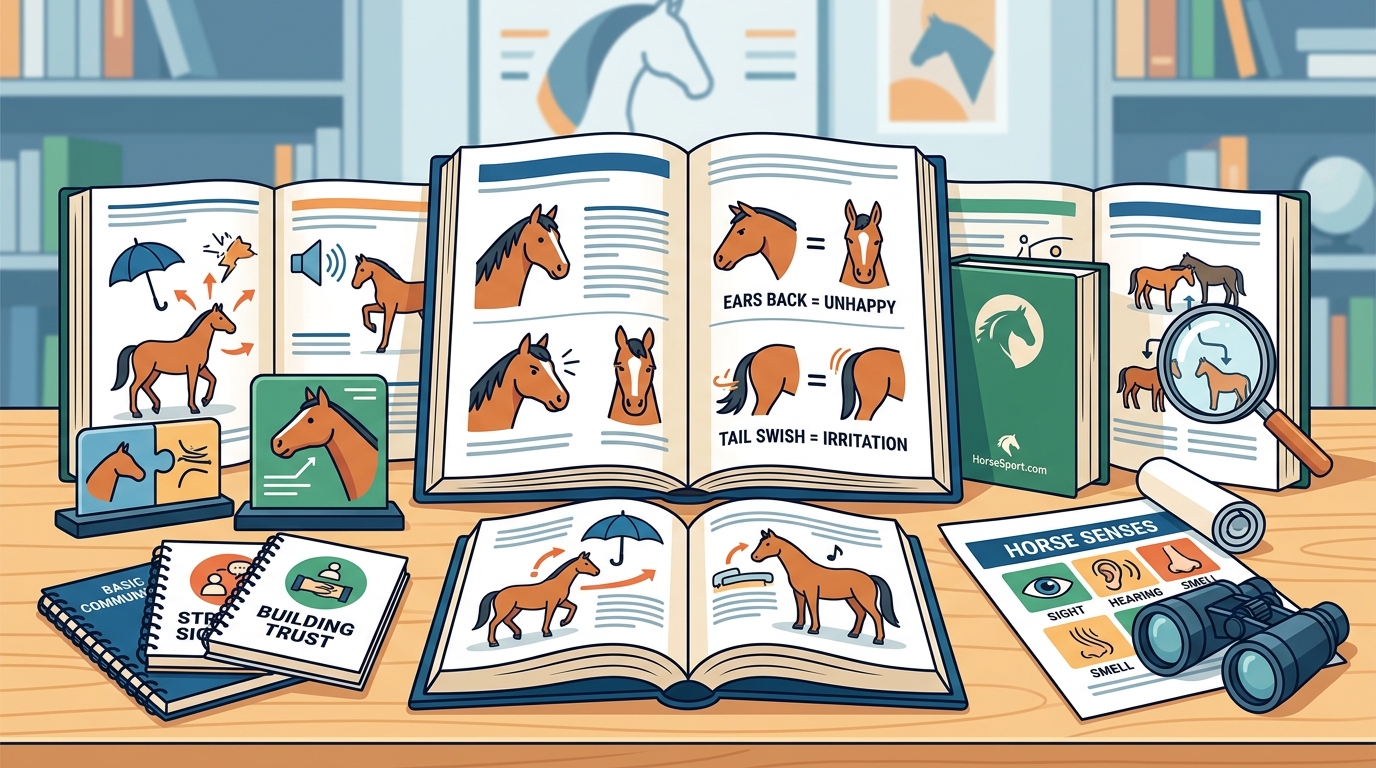
Reading a horse means observing with all your senses and taking in all signals without judgment. Beginners should start by watching horses at rest in the pasture before attempting to interpret behavior under saddle. Focus on these areas:
- Ears: Forward ears usually signal curiosity; pinned-back ears can indicate irritation or aggression.
- Tail: A relaxed, gently swishing tail is normal; rapid swishing or a clamped tail often indicates discomfort.
- Eyes: Soft eyes with a relaxed brow suggest calm; wide eyes with visible sclera (white) can signal fear.
- Mouth: Licking and chewing may indicate processing; tight lips and jaw tension can suggest stress.
Research presented at the 2024 International Society for Equitation Science conference reinforced that observing the totality of a horse's signals, not isolated cues, is the key to accurate interpretation.
Behavior Problems vs. Pain: What Beginners Miss
Many behaviors labeled as "naughty" or "stubborn" actually stem from pain. Lauren Fraser writes in her article on pain and behaviour problems in horses that undesirable behaviors such as biting, kicking, bucking, or bolting may be indicators of underlying discomfort. Pain is a physical and psychological experience that occurs when an animal is exposed to elements that could damage their body.
The Horse Grimace Scale (HGS) is a validated tool that considers subtle changes in facial expressions resulting from pain. It has been tested with horses experiencing castration, laminitis, and dental pain. Beginners should always consult a veterinarian before assuming a behavior issue is purely a training problem.
The Science Behind Horse Behavior
Modern equine science has shown that horses possess cognitive abilities once thought reserved for primates. Italian researcher Paolo Baragli demonstrated in replicated studies (2017; 2021) that horses possess mirror self-recognition, as covered in the article on horses and self-awareness. Horses also display grief-like behaviors when a companion dies, according to a UK-Italy study published via ScienceDirect.
Positive reinforcement is gaining ground in equine training. A study at Delaware Valley University found that using differential reinforcement reduced mounting-block avoidance behaviors by 92.9% and cut average mounting time from 86 seconds to just 18.5 seconds, as reported in Horse Sport's coverage of solving mounting block avoidance.
Key Takeaways
- Start with a trusted editorial source like HorseSport.com's Behaviour section, which publishes research-backed articles written for general audiences.
- Learn body language basics before interpreting behavior under saddle; observe horses at rest first.
- Always rule out pain before labeling a behavior as a training issue; use tools like the Horse Grimace Scale.
- Horses are social animals whose need for companionship is an ethological necessity, not a flaw to be "fixed."
- Positive reinforcement methods are supported by peer-reviewed research and can dramatically improve common behavior problems.
- University programs like Equine Guelph offer affordable online courses that pair well with reading articles.
- Revisit foundational behavior articles regularly; your understanding will deepen as your hands-on experience grows.
Frequently Asked Questions
What is equine behavior?
Equine behavior is how horses communicate, interact socially, respond to stimuli, and express emotional states. It encompasses everything from grazing patterns to flight responses and is studied through the field of equine ethology.
Where can I find free horse behavior articles for beginners?
HorseSport.com publishes a full Behaviour category with expert-written articles that are free to read. University extension sites such as Equine Guelph also offer accessible educational content.
How do I tell if my horse is stressed?
Common signs include excessive sweating, rapid breathing, high head carriage, wide eyes, tail clamping, and repetitive movements like weaving or stall walking. Persistent stress can also lead to gastric ulcers and weight loss.
Can beginners use positive reinforcement with horses?
Yes. Positive reinforcement, sometimes called clicker training, is simple to learn and well-supported by research. Start by rewarding a horse for standing quietly, then gradually shape more complex behaviors.
Why does my horse act differently around other horses?
Horses are herd animals with strong social bonds. Changes in behavior around other horses often relate to dominance hierarchies, separation distress, or feeding competition. Understanding herd dynamics is essential for safe management.
Are horse behavior problems always caused by pain?
Not always, but pain is one of the most under-recognized causes of behavior problems. A veterinary exam should be the first step whenever a behavior change is sudden or unexplained.
What is the Horse Grimace Scale?
The Horse Grimace Scale is a research-validated assessment tool that uses subtle changes in facial expression to detect pain in horses. It evaluates ear position, eye tension, nostril shape, and jaw tightness.
How often should I read about horse behavior?
Regularly. Equine science evolves quickly. Subscribing to a newsletter from a trusted source ensures you stay current with new findings that can improve your horsemanship.
Your Next Step
Ready to start building your knowledge? Browse the Horse Sport Behaviour section and bookmark three articles that match your current challenges. Then sign up for the Horse Sport newsletter so new behavior research lands in your inbox every week.