

Understanding why horses act the way they do is one of the most valuable skills any new equestrian can develop. Whether your horse pins its ears during grooming, dances at the mounting block, or screams for barn mates at a show, the answers almost always live in equine behavior science. The challenge for beginners is knowing where to look and what to trust. This guide walks you through practical steps for finding reliable, research-backed horse behavior articles so you can build a stronger partnership with your horse from day one.
Why Horse Behavior Knowledge Matters for Beginners
Horses communicate almost entirely through body language. A beginner who cannot read those signals risks misinterpreting fear as stubbornness or pain as disobedience. According to equine behavior researcher Lauren Fraser, writing for Horse Sport, undesirable behaviors such as biting, kicking, bucking, or bolting may actually be indicators of pain rather than bad attitude.
Learning to decode these signals early prevents dangerous misunderstandings and builds a foundation of empathy. Behavioral literacy is the ability to observe and correctly interpret a horse's physical and emotional cues. It is a skill that separates safe, effective horsemanship from guesswork.
What Is Equine Behavior Science?
Equine behavior science is the study of how horses perceive, learn, and respond to their environment and human interactions. It draws on ethology, psychology, and veterinary medicine. Organizations like the International Society for Equitation Science (ISES) hold annual conferences where researchers present peer-reviewed findings on topics from conflict behaviors in dressage to mounting block avoidance.
Operant conditioning is a learning process in which a horse's voluntary behavior is shaped by consequences such as rewards or the removal of pressure. Understanding this concept helps beginners see why certain training methods work and others backfire.
Where to Find Trustworthy Horse Behavior Articles
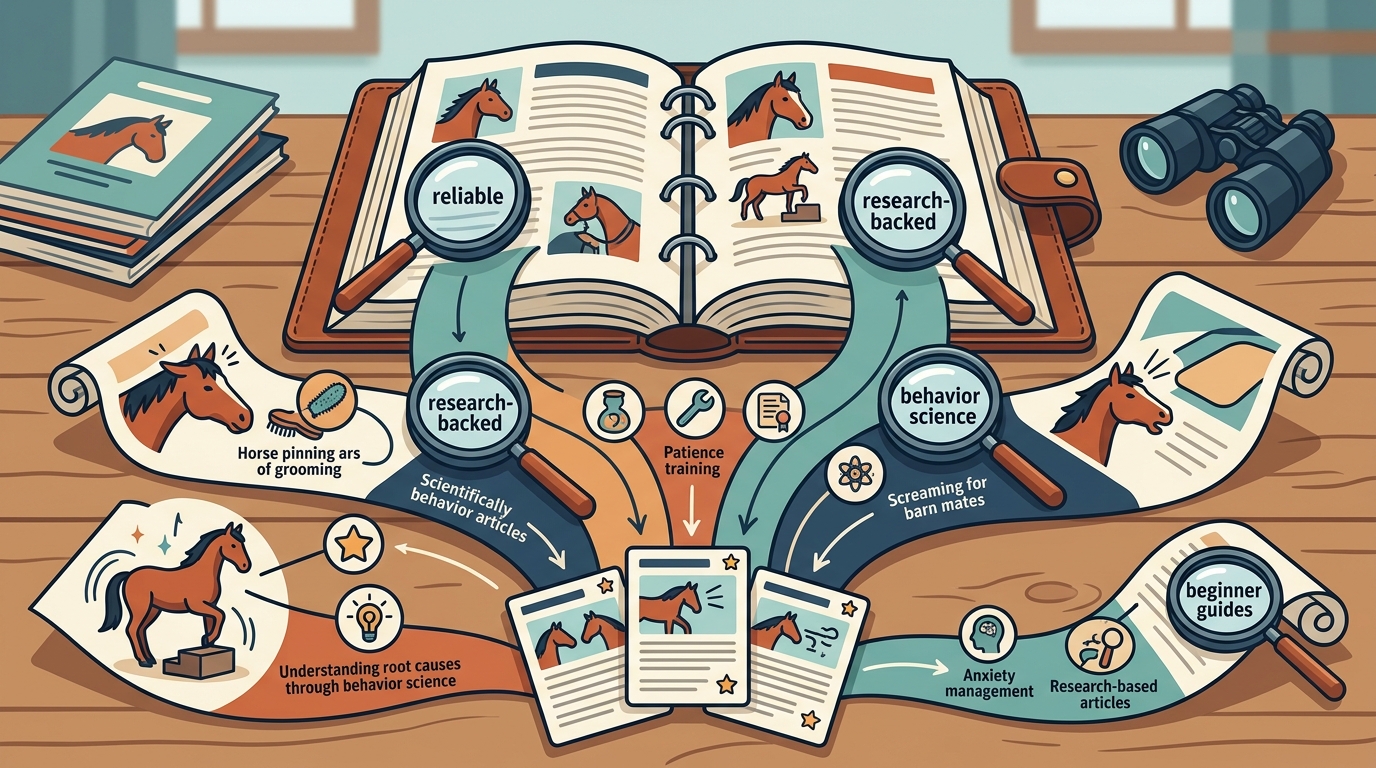
Dedicated Behavior Sections on Equestrian Publications
The fastest route to quality content is a publication with a dedicated behavior category. Horse Sport, Canada's equestrian authority for over 50 years, maintains an entire Behaviour section filled with expert-written articles covering topics from equine emotional well-being to feeding aggression in group settings.
University and Research Institution Resources
Peer-reviewed journals such as Applied Animal Behaviour Science and the Journal of Equine Veterinary Science publish original research. For example, Italian equine behaviorist Paolo Baragli's 2021 study demonstrated that horses possess mirror self-recognition, expanding our understanding of equine cognition.
Books by Recognized Experts
Titles like 25 Ways to Make Your Horse Happy by Anne Kruger-Degener and The Rider's Guide to Real Collection by Lynn Acton offer deep dives into behavior that complement shorter articles. Horse Sport regularly features excerpts and reviews of these works.
Essential Behavior Topics Every Beginner Should Read
The table below outlines core behavior topics, why they matter, and where to start reading on Horse Sport.
| Topic | Why It Matters | Recommended Article |
|---|---|---|
| Pain and behavior | Many "bad" behaviors are pain responses | Pain and Behaviour Problems in Horses |
| Separation distress | Herd-bound behavior is normal, not pathological | Understanding Equine Separation Distress |
| Boredom and stereotypies | Stall-kept horses need enrichment | Is My Horse Bored? |
| Positive reinforcement | Reward-based training improves learning and welfare | Positive Reinforcement in Equine Training |
| Equine personality | Matching horse and rider temperament prevents frustration | Understanding Equine Personality |
| Grief and social bonds | Horses form deep attachments that affect welfare | Do Horses Grieve the Loss of a Friend? |
How to Evaluate the Quality of a Behavior Article
Check the Author's Credentials
Look for articles written or reviewed by professionals with relevant qualifications. For instance, Antonia J.Z. Henderson, PhD, authored Horse Sport's pieces on positive reinforcement and stallion behavior, grounding each article in published research.
Look for Cited Studies
Trustworthy behavior articles reference specific research. A quality article will name the researchers, the institution, and ideally the publication. Avoid articles that make sweeping claims such as "horses are just stubborn" without evidence.
Beware of Anthropomorphism
Anthropomorphism is the attribution of human emotions or intentions to animals without scientific basis. As trainer Anne Kruger-Degener explains, reading a horse means "observing with all your senses, taking in all signals without judgment." Articles that project complex human motives onto horses are generally less reliable.
Building Your Personal Reading List
Start by bookmarking publications with dedicated behavior sections. Subscribe to the Horse Sport newsletter for weekly updates that include new behavior articles alongside training, nutrition, and welfare content. Set aside 15 to 20 minutes per week for focused reading.
Supplement your reading with podcast episodes and video content. Horse Sport's "Hitting Your Stride" podcast has featured guests like multi-discipline trainer Caleb Clingen discussing foundational training principles that are rooted in behavioral understanding.
Finally, discuss what you read with your instructor or barn community. Applying new knowledge in conversation and practice accelerates learning far more than passive reading alone.
Key Takeaways
- Horse behavior literacy is essential for rider safety and equine welfare.
- Equine behavior science draws on ethology, psychology, and veterinary medicine to explain why horses act the way they do.
- Publications with dedicated behavior categories, like Horse Sport's Behaviour section, provide the most consistent stream of beginner-friendly content.
- Always check author credentials and cited research before trusting a behavior article.
- Core beginner topics include pain-related behavior, separation distress, boredom, positive reinforcement, and equine personality.
- Peer-reviewed sources such as Applied Animal Behaviour Science offer the highest level of evidence.
- Consistent weekly reading paired with real-world application builds lasting behavioral literacy.
Frequently Asked Questions
What is the best website for beginner horse behavior articles?
Horse Sport maintains an extensive Behaviour section with articles written by PhDs and certified behaviorists, making it an excellent starting point for beginners seeking evidence-based content.
How do I know if a horse behavior article is trustworthy?
Look for named authors with relevant credentials, references to published studies, and affiliations with recognized organizations like ISES or universities. Avoid articles that rely solely on anecdotal advice.
What is the most important horse behavior topic for beginners?
Understanding the link between pain and behavior is arguably the most critical starting point. Many common behavior problems, from bucking to refusing to load, can stem from undiagnosed pain.
Are there free horse behavior resources online?
Yes. Horse Sport publishes most of its behavior articles for free. University extension programs, such as those from the University of Guelph, also offer accessible equine science content.
How often should I read about horse behavior?
Aim for at least one in-depth article per week. Pairing your reading with observation time at the barn helps connect theory to real-world behavior patterns.
Can understanding behavior help me become a better rider?
Absolutely. Riders who understand equine body language can adjust their aids, timing, and approach to training. Research from riding schools shows that instructor focus on behavioral feedback reduces back pain in lesson horses and improves rider outcomes.
What is the difference between behavior and training articles?
Behavior articles explain why horses act a certain way, drawing on science and ethology. Training articles focus on how to teach specific skills. The best training articles incorporate behavioral science, and the best behavior articles offer practical applications.
Start Building Your Equine Behavior Library Today
Ready to deepen your understanding of your horse? Browse the full collection of expert-written articles in the Horse Sport Behaviour section and subscribe to the newsletter for new research summaries delivered to your inbox every week.