
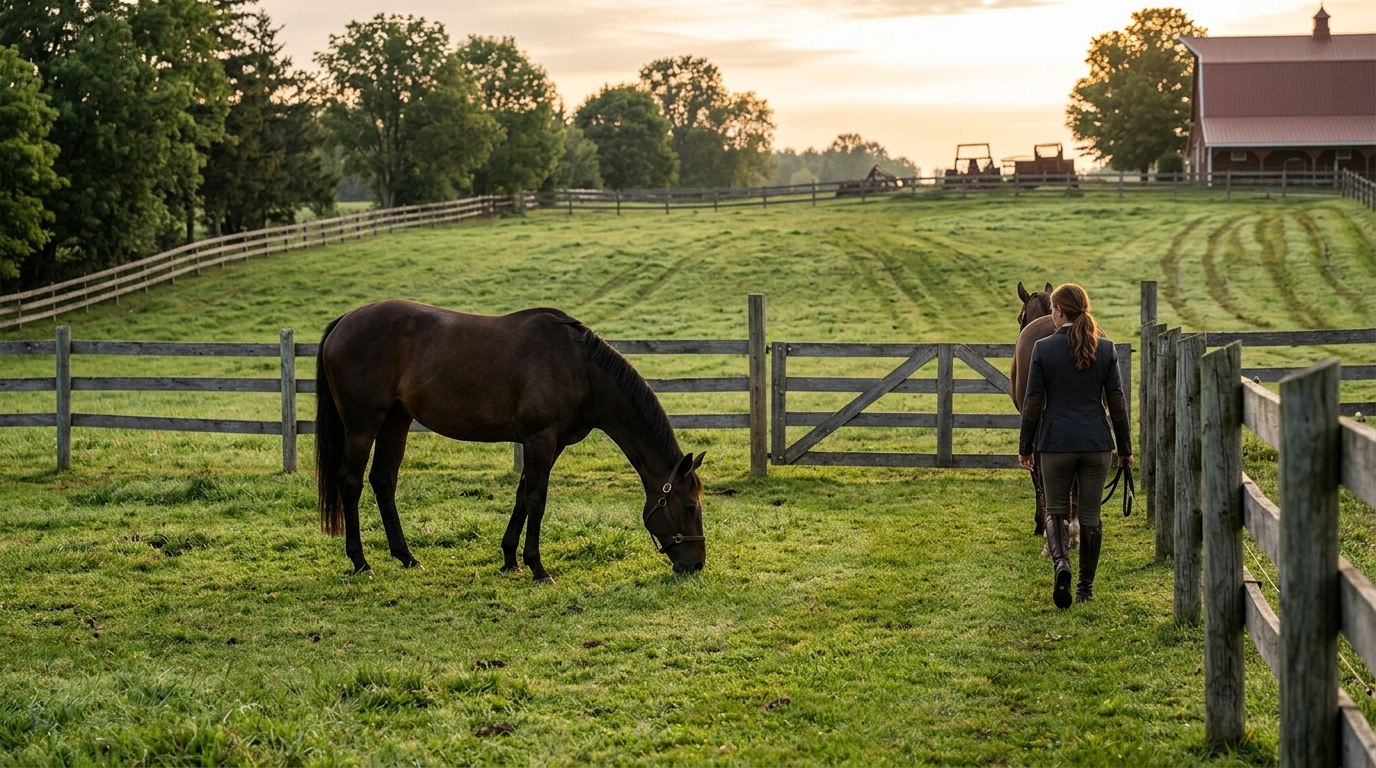
Healthy pastures are the foundation of good horse keeping. Well-managed grazing land provides free, nutrient-dense forage, promotes natural exercise, and supports your horse's digestive and mental well-being. Yet many horse owners focus so intently on their animals that they neglect the land beneath those hooves. Whether you manage two acres or two hundred, the principles of effective pasture management remain the same: start with the soil, rotate your grazing, control weeds, and plan by season. This guide walks you through every essential practice so your fields stay productive year after year.
Why Pasture Management Matters
Forage is the most important component of an equine diet after water. Pasture offers significant advantages over hay, including higher levels of energy, protein, and vitamins E and beta-carotene, which degrade after cutting. Horses allowed to graze also benefit from natural exercise and the ability to self-regulate their feeding schedule. As noted by equine nutrition experts at Horse Sport, maximizing pasture use during the growing season is in every owner's best interest.
Neglecting pasture health leads to overgrazing, soil compaction, weed invasion, and erosion. These problems increase feed costs and can expose horses to health risks such as laminitis, colic, and parasite loads. Investing time in management pays dividends in healthier horses and lower hay bills.
Start With Soil Health
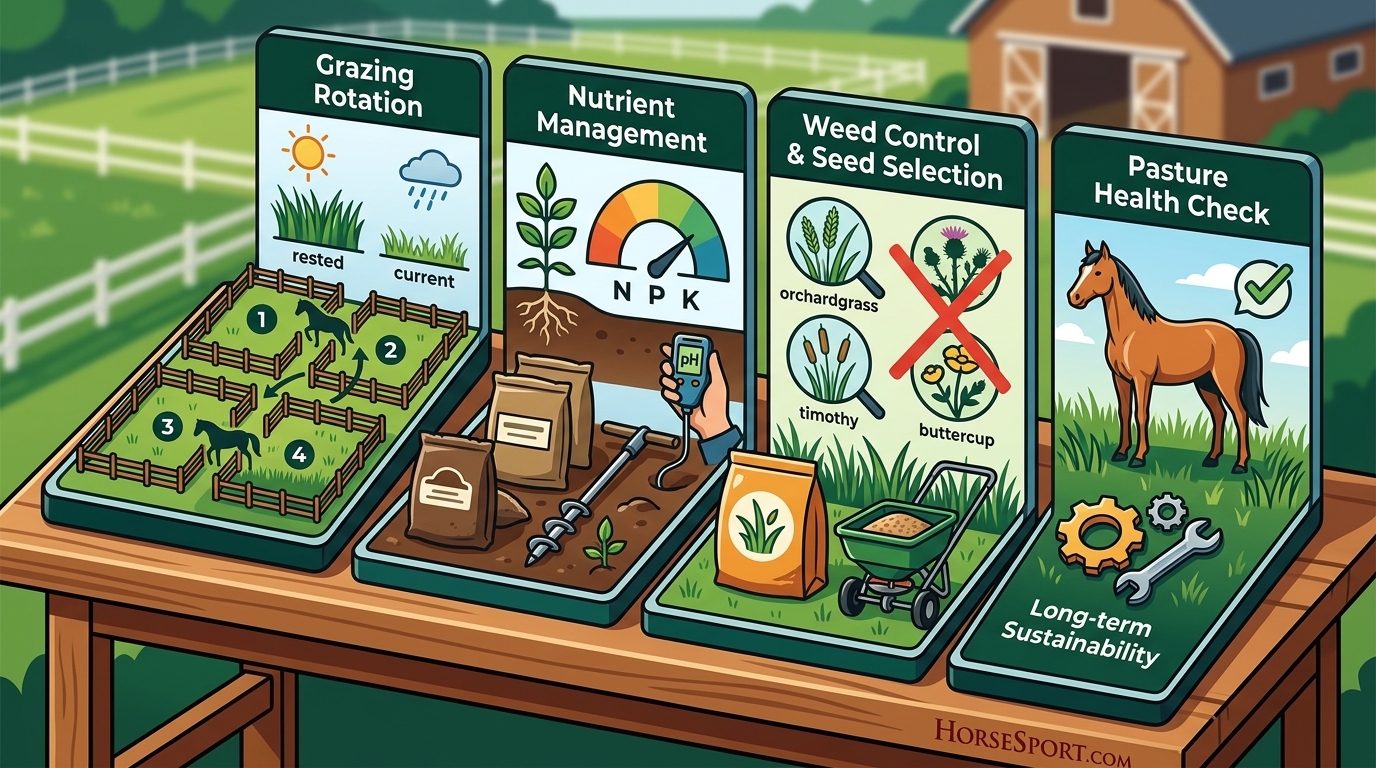
Soil testing is the first step in any pasture improvement plan. A soil test reveals pH levels, nutrient deficiencies, and organic matter content. According to Rutgers Equine Science Center, pastures perform best at a pH of 6.0 to 7.0, with 6.5 being optimal for maximum nutrient utilization. Lime can be applied any time of year to correct acidic soils, though it takes about six months to react.
Soil Testing Frequency
Test your soil at least every two to three years. If you are actively renovating pastures, annual testing is preferable. Testing kits are available through most county extension offices.
Building Root Diversity
Healthy soil means a diversity of root structures. As Dr. Kimberley Schneider of the University of Guelph explains on Horse Sport, pastures with mostly grasses can be nitrogen deficient, whereas those with more than 30% legumes are naturally rich in nitrogen and may not need additional fertilizers.
Rotational Grazing Strategies
Rotational grazing is a management practice that gives grazed pastures a period of rest and recovery. It is widely regarded as the single most effective strategy for maintaining productive horse pastures. The concept is straightforward: divide your pasture into smaller paddocks and move horses between them on a regular schedule.
How to Set Up a Rotation
Dr. Schneider suggests starting with a minimum of four paddocks large enough to accommodate your herd. According to Horse Sport's eco-guide to pasture management, horses should have access to a single paddock for no more than five days at a time. Once grass is grazed down to 8 to 10 centimetres, rotate to a fresh area.
Rest Periods
Rest periods vary by season. In spring, regrowth may take just two to three weeks, while hot, dry summer conditions can require a month or more. The Penn State Extension recommends starting grazing when grasses reach 8 to 10 inches and moving horses when they are grazed to 4 to 5 inches.
Stocking Rates and Acreage Planning
Stocking rate is the total number of pasture acres available per horse. Getting this number right is critical to preventing overgrazing. Recommendations vary by source and region, but the following table summarizes common guidelines.
| Source | Recommended Acres per Horse | Notes |
|---|---|---|
| Equine Guelph (Ontario) | 2 to 3 acres | For nutritional needs via grazing alone |
| University of Minnesota Extension | 2 acres per 1,000 lbs | For pasture as primary nutrition source |
| Rutgers Cooperative Extension | 1 to 2 acres | Temperate climates with management |
| Penn State Extension | 2 to 4 acres | Low management; higher density needs rotation |
Keep in mind that stocking rates change with the seasons. A pasture that supports three horses per acre during peak spring growth may only support half a horse per acre in the heat of summer.
Fertilization and Weed Control
Fertilization is the process of applying essential nutrients to the soil to promote forage growth. Nitrogen (N) drives leafy green growth, phosphorus (P) supports root development, and potassium (K) helps plants survive stress like drought and freezing. According to Horse Sport's spring pasture management guide, applying nitrogen in early spring jump-starts plant growth, and horses should be removed from pasture until rain washes fertilizers off the leaves and into the soil.
Weed Management
A healthy, dense pasture is your best defense against weeds. Mowing before weeds produce seed heads limits their spread. Regular mowing also keeps forage immature and higher in protein and energy. For persistent problems, targeted herbicide application may be necessary, but always identify the weed species first since product efficacy varies.
Seasonal Pasture Management
Pasture management is not a one-time event but a year-round system. Each season brings specific priorities.
Spring
Keep horses off pastures until grass reaches 5 to 6 inches of growth. Introduce horses to spring grass gradually, starting with 15 minutes per day and increasing incrementally. Spring pasture can be very rich in sugars, starch, and fructans, which can trigger laminitis in susceptible horses. Learn more about managing seasonal pasture risks on Horse Sport.
Summer
Continue rotational grazing and mow after each rotation. Monitor for drought stress, which concentrates sugars in plants. Supplement with hay if pasture growth slows significantly.
Fall and Winter
After a killing frost, keep horses off pasture for at least seven days. Transition horses from pasture to a hay-based diet gradually. Winter is ideal for planning next year's pasture projects, pricing out fencing, and frost-seeding bare areas. Review your approach to forage alternatives if hay shortages are anticipated.
Manure Management
Manure management is the systematic handling of horse waste to protect pasture health, water quality, and reduce parasite loads. A 1,000-pound horse produces roughly nine tons of manure per year. Left unmanaged, manure creates bare spots, harbors parasites, and can contaminate water sources.
Harrowing is the process of dragging pastures to break up manure clumps, expose parasites to sunlight, and distribute nutrients more evenly. Complete harrowing after horses are rotated out and allow two to three days of rest before reintroducing them. For farms with larger operations, composting manure into windrows can produce valuable fertilizer. As detailed in Horse Sport's manure management feature, composted manure can improve pasture yield and even become a revenue source.
Key Takeaways
- Test your soil every two to three years and adjust pH to the 6.0 to 7.0 range for optimal forage growth.
- Implement rotational grazing with at least four paddocks and limit access to five days per paddock.
- Plan for 2 to 3 acres per horse if pasture is the primary nutrition source.
- Apply nitrogen in split applications (spring, late June, early September) for best results.
- Mow regularly to control weeds and maintain high-quality, leafy forage.
- Manage seasonal transitions carefully, especially during spring green-up and after fall frosts.
- Harrow or pick manure consistently to reduce parasite loads and promote even nutrient distribution.
Frequently Asked Questions
How many acres does one horse need for grazing?
Most experts recommend 2 to 3 acres per horse when pasture is the primary forage source. On well-managed land with rotational grazing and hay supplementation, as little as 1 to 2 acres may suffice in temperate climates.
What is rotational grazing?
Rotational grazing is a system where horses are moved between multiple paddocks on a schedule, allowing grazed areas to rest and regrow. Even a simple two-paddock system produces measurable benefits.
How often should I test my pasture soil?
Soil testing should be done every two to three years at minimum. Annual testing is recommended during active pasture renovation or when correcting pH and nutrient imbalances.
When should I keep horses off pasture in fall?
Horses should be removed from pasture for at least seven days after a killing frost, which is a frost severe enough to end the growing season. This allows dangerous sugar spikes in grasses to subside.
What is the best grass for horse pastures?
A mix of cool-season grasses and legumes works best for most temperate regions. Common choices include timothy, orchardgrass, Kentucky bluegrass, perennial ryegrass, and clover. Species selection depends on your region, climate, and soil type.
How do I prevent overgrazing?
Prevent overgrazing by implementing rotational grazing, maintaining proper stocking rates, using sacrifice areas during wet or dormant seasons, and supplementing with hay when pasture growth slows.
Should I drag manure in horse pastures?
Yes. Harrowing breaks up manure clumps, distributes nutrients evenly, and exposes parasite larvae to sunlight. Always harrow when horses are rotated out and allow a rest period before returning them.
How do I introduce horses to spring pasture safely?
Start with 15 minutes of grazing per day and increase by 15 minutes daily. Wait until grass reaches 5 to 6 inches before allowing any grazing. Monitor horses with metabolic conditions closely, as spring grasses are highest in non-structural carbohydrates.
Take the Next Step for Your Pasture
Great pasture management starts with a plan. Begin by scheduling a soil test this season, mapping out your paddock rotation, and reviewing your stocking rates. For more expert advice on farm management, nutrition, and horse health, explore the latest articles at Horse Sport, Canada's equestrian authority.