
Good nutrition is the cornerstone of every healthy, high-performing horse. Yet many owners unknowingly leave gaps in their feeding programmes — gaps that manifest as lacklustre coats, weak hooves, unexplained behavioural changes, or recurring bouts of colic. This ultimate guide breaks equine nutrition into its essential pillars so you can audit your current programme, identify shortfalls, and make targeted improvements.
Pillar 1 — Understand the Equine Digestive System First
Before tweaking a single ingredient, it helps to appreciate why horses eat the way they do. The entire digestive tract of a mature light horse stretches roughly 100 feet — about a third of the length of a football field. The large cecum and colon harbour massive microbial populations that ferment fibre much like a cow's rumen, but because the horse is a hindgut fermenter the order of digestion matters enormously.
If large quantities of starch-rich concentrates bypass the small intestine and reach the cecum, they ferment rapidly and can produce excessive gas or lactic acid, triggering colic or laminitis. This is why forage-first feeding is not just a preference — it is a physiological necessity.
Pillar 2 — Get Forage Right: Quality, Quantity, and Testing
Forage — whether pasture grass, hay, or haylage — is the single most important component of any equine diet. Current veterinary guidance states that horses should receive at least 1.5–2 per cent of their body weight in forage per day on a dry-matter basis. For a 500 kg horse, that translates to roughly 7.5–10 kg of hay daily.
Why hay testing matters
Not all hay is created equal. Attractive green bales can still be nutrient-poor, while less visually appealing cuts may actually deliver higher digestible energy. A laboratory forage analysis reveals the exact levels of protein, fibre (ADF and NDF), sugars, and minerals in your hay. Aim for forages with an acid-detergent fibre (ADF) below 45 per cent and a neutral-detergent fibre (NDF) below 65 per cent, as horses do not digest poor-quality, high-fibre forages effectively.
Slow-feed strategies
Mimicking a horse's natural trickle-feeding behaviour is beneficial for gut health and mental well-being. Research from the University of Minnesota found that horses took around 6.5 hours to consume hay from a small-holed slow-feed net compared to about 3 hours when hay was fed loose on the stall floor. Overweight horses fed from hay nets also showed lower peak insulin and cortisol values — a meaningful benefit for metabolically challenged individuals.
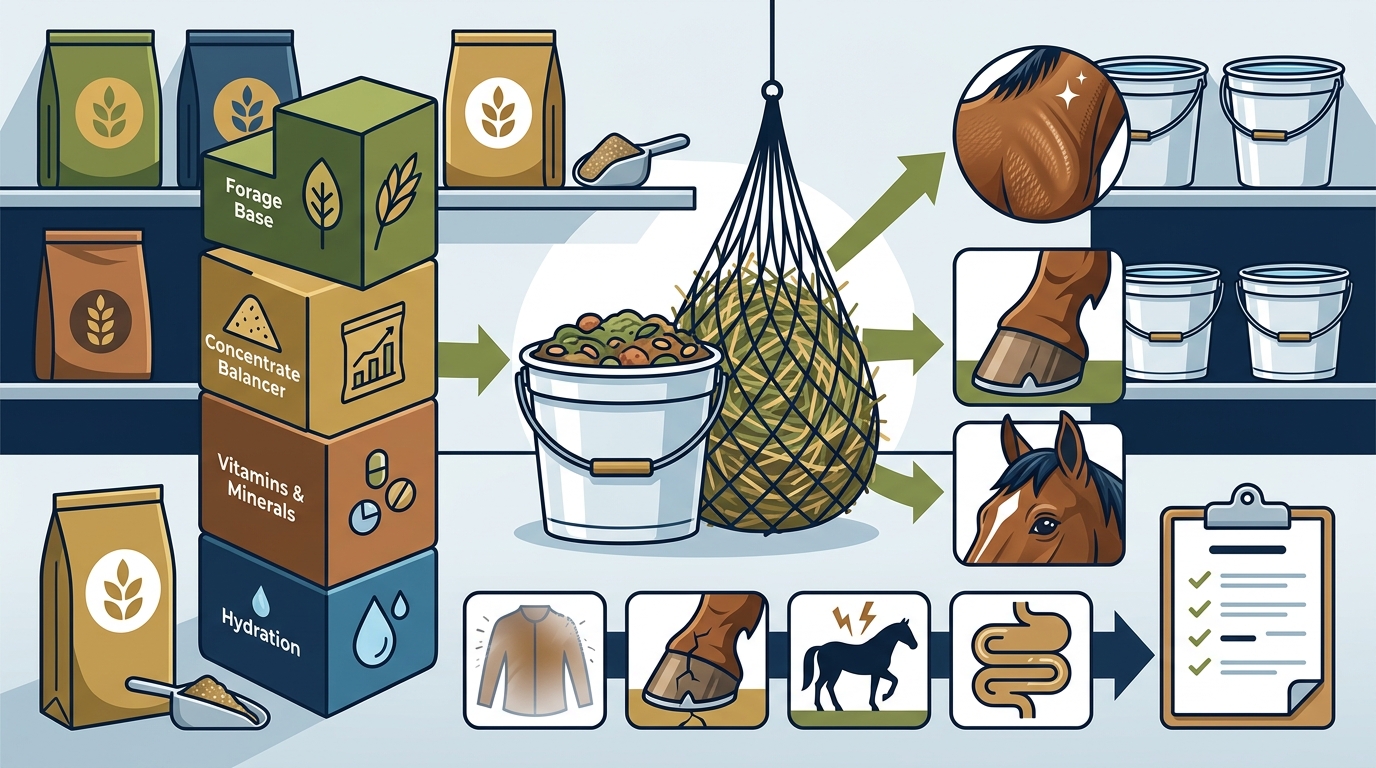
Pillar 3 — Close Mineral and Vitamin Gaps
Even well-managed forage-based diets almost always fall short on certain trace minerals and vitamins. The most common deficiencies in forage-only diets are sodium, copper, and zinc. Soil composition, grass species, and regional climate all influence what your hay actually delivers, which is another reason a forage analysis is so valuable.
Key mineral ratios to watch
- Calcium to phosphorus: Must stay above 1 : 1, with an ideal target of roughly 1.5 : 1. An inverted ratio inhibits calcium absorption and can cause nutritional secondary hyperparathyroidism — sometimes called 'Big Head Disease'.
- Zinc to copper: Nutritionists commonly aim for a 3 : 1 to 4 : 1 zinc-to-copper ratio to maintain balance between these trace minerals and prevent induced copper deficiency.
Vitamins A, D, and E
Fresh green pasture is rich in vitamins A and E, but these levels decline substantially in stored hay. Horses can synthesise vitamin D through exposure to sunlight — typically 4 to 6 hours daily is sufficient — so deficiency is uncommon for horses with regular turnout. Vitamin E, however, deserves special attention in horses kept predominantly on hay, as grinding and prolonged storage reduce its concentration.
Pillar 4 — Choose the Right Concentrate or Supplement Type
Not every horse needs a bucket feed. The decision tree for supplementation depends on your horse's body condition, workload, and what your forage analysis reveals.
Option A: Ration balancer
Ration balancers are low-calorie, nutrient-dense pellets designed to supply the protein, vitamins, and minerals that forage alone cannot provide. They are typically fed at just 1–2 pounds per day. They are ideal for easy keepers, horses on a weight-management programme, or any horse that maintains condition on forage alone. A quality ration balancer will include essential amino acids like lysine and methionine, organic trace minerals, and B-vitamins including biotin for hoof support.
Option B: Fortified feed
Fortified feeds combine energy with vitamins and minerals at a moderate feeding rate of roughly 5–10 pounds per day. They suit horses that need additional calories — hard keepers, performance horses, lactating mares, or growing youngstock. A critical but often overlooked rule: if you feed below the manufacturer's recommended rate, your horse may not receive adequate vitamin and mineral levels, and a separate supplement or balancer should fill the gap.
Option C: Concentrated vitamin-mineral supplement
These products have very small serving sizes — typically 30–200 grams per day. They provide vitamins and trace minerals but generally do not include significant protein or macrominerals. They suit mature horses whose protein and calcium needs are already met through forage.
Pillar 5 — Manage Energy for Workload
The nutritional requirement that changes the most with exercise is digestible energy. Performance horses have markedly higher energy and protein requirements than horses at maintenance. In high-intensity disciplines like racing, jumping, or polo, energy requirements may increase by as much as 100 per cent compared to a horse at rest.
Fat as a calorie source
Fat is calorie-dense and provides a cool, slow-release energy source that can be added at up to 10 per cent of the total diet. Supplemental fat — such as stabilised rice bran or flaxseed oil — is especially useful for horses that become 'hot' on high-starch diets. Fat also supplies linoleic acid, which supports healthy skin and coat condition.
Avoid concentrate overload
Individual concentrate meals should not exceed 0.5 per cent of body weight to minimise digestive upset. For a 500 kg horse, that means no more than 2.5 kg of hard feed per meal. If calorie demands are high, split concentrate into multiple smaller feeds throughout the day rather than delivering two large meals.
Pillar 6 — Hydration and Electrolytes
Water is the most overlooked nutrient. Horses that refuse to drink are at risk of poor performance, compromised organ function, and colic. Always ensure free access to fresh, clean water.
Salt (sodium chloride) is crucial for water balance, muscle contraction, and acid-base regulation. Horses are unique among domestic species in that they lose significant electrolytes through sweat. Hard-working horses can lose more than 30 grams of NaCl in just 1–2 hours. A properly balanced electrolyte supplement is quickly absorbed from the gastrointestinal tract and should be offered alongside water during and after heavy exercise. At minimum, every horse should have access to a plain white salt block year-round.
Pillar 7 — Transition Any Diet Change Slowly
Gut microbes are highly sensitive to substrate changes. Any dietary adjustment — whether introducing a new hay batch, adding a supplement, or switching concentrates — should be phased in gradually over 10 to 14 days. Abrupt changes can disturb microbial balance, cause a pH crash in the hindgut, and lead to gas colic, diarrhoea, or laminitis.
A practical approach: on days 1–3, replace roughly 25 per cent of the old feed with the new. Increase to 50 per cent on days 4–6, then 75 per cent on days 7–10, reaching 100 per cent by day 11–14. Monitor manure consistency throughout the transition.
Pillar 8 — Monitor, Reassess, Repeat
Nutrition is never 'set and forget'. Body condition scoring on a regular schedule — at least monthly — lets you detect subtle weight changes before they become problems. Seasonal shifts in pasture quality, changes in workload, ageing, and reproductive status all warrant a fresh look at the feeding plan.
Work with professionals
An equine nutritionist can analyse your forage results alongside your horse's individual profile — breed, age, discipline, health history — and formulate a ration that avoids both deficiencies and costly over-supplementation. Many feed companies and veterinary extension programmes offer forage-testing services and free or low-cost consultations.
Key Takeaways
- Forage should form the foundation of every equine diet — aim for 1.5–2% of body weight daily on a dry-matter basis.
- Test your hay so you know exactly what it provides and where the gaps are.
- All forage-only diets need mineral and vitamin supplementation — at minimum, salt, copper, and zinc.
- Choose between a ration balancer, fortified feed, or concentrated supplement based on your horse's calorie needs.
- Keep the calcium-to-phosphorus ratio above 1 : 1 and ideally near 1.5 : 1.
- Transition any feed change over 10–14 days to protect hindgut microbial balance.
- Provide free-choice water and a salt source at all times, and add electrolytes for horses in moderate-to-heavy work.
- Reassess the diet whenever workload, season, or life stage changes.
Frequently Asked Questions
How much forage does a horse need per day?
Current recommendations advise at least 1.5–2 per cent of body weight in forage daily on a dry-matter basis. This can be pasture, hay, haylage, or forage substitutes like hay cubes and beet pulp.
What is a ration balancer and does my horse need one?
A ration balancer is a nutrient-dense, low-calorie pellet that delivers vitamins, minerals, and amino acids at a small feeding rate of 1–2 pounds per day. It is ideal for horses that hold weight on forage alone but still need micronutrient support.
Why is the calcium-to-phosphorus ratio so important?
Maintaining a ratio above 1 : 1 — ideally around 1.5 : 1 — prevents skeletal abnormalities. An inverted ratio can inhibit calcium absorption and result in nutritional secondary hyperparathyroidism, a serious condition affecting bone integrity.
How slowly should I change my horse's diet?
All dietary changes should be phased in over roughly 10–14 days. The microbial ecosystem in the hindgut needs time to adapt to new substrates; rushing the process risks colic, diarrhoea, or laminitis.
Does my horse need electrolytes?
Every horse needs access to plain salt at a minimum. Working horses lose significant sodium chloride through sweat — potentially more than 30 grams in just 1–2 hours of intense effort — so a balanced electrolyte supplement becomes important during and after exercise.