
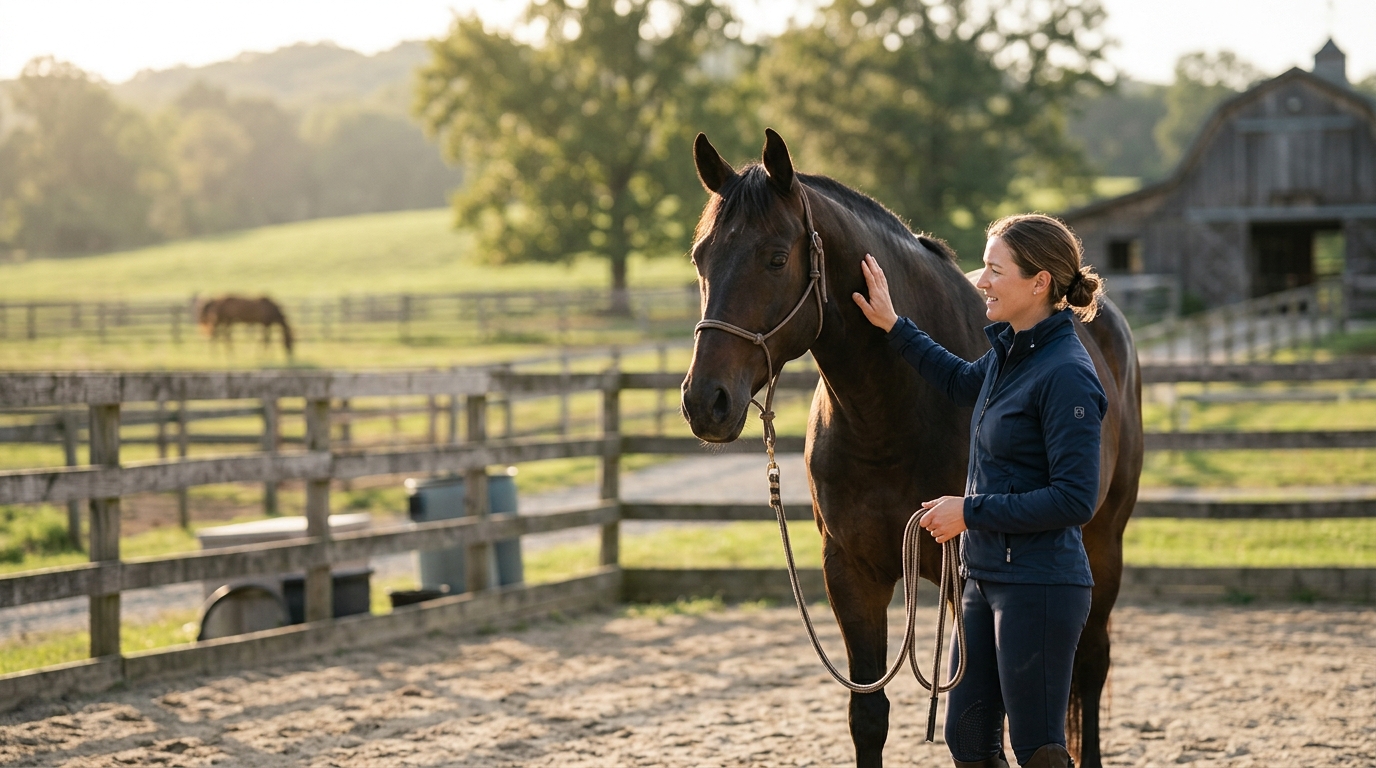
Whether you are starting a young horse under saddle or resolving a dangerous habit in a seasoned mount, the approach you choose matters — for your safety and your horse's welfare. This guide breaks down the most effective, research-supported methods for training horses and modifying unwanted behaviors, so you can build a partnership rooted in clarity and trust.
Why Understanding Learning Theory Matters
Learning theory is the scientific framework that explains how horses acquire and retain new information. Equitation science — the study of horse–human interaction — has advanced our understanding of how to apply these principles ethically and effectively.
Training can be far more efficient when it aligns with the horse's natural cognitive abilities. Research published in Equine Welfare in Clinical Practice (2025) underscores that training is most efficiently achieved when the learning abilities of the horse are understood, and that equitation science has produced major advances in understanding how to modify equine behavior.
Despite this, studies show that many equestrians — including professionals — struggle to accurately describe basic learning-theory concepts. This knowledge gap can have real welfare consequences: when riders cannot articulate how their horses learn and think, there is a risk of miscommunication and stress throughout training.
The Four Quadrants of Operant Conditioning in Horse Training
All deliberate horse training falls within the framework of operant conditioning, which includes four quadrants. Understanding each one helps you choose the right tool for the moment.
1. Positive Reinforcement (R+)
Positive reinforcement adds something the horse values — usually a food reward, wither scratch, or verbal praise — immediately after a desired behavior. This increases the likelihood the horse will repeat that behavior.
- Clicker training is the most popular R+ tool. The click marks the exact moment the horse performs the desired behavior, and a treat follows. Once the handler and horse are properly conditioned to the clicker, this form of training is highly positive and effective for teaching almost any behavior and eliminating undesirable ones.
- Research from Linköping University found that horses given just eight to nine weeks of regular, short positive-reinforcement sessions showed a significant increase in contact-seeking behavior toward unfamiliar humans.
- A peer-reviewed study comparing reinforcement schedules concluded that horses trained under a positive reinforcement schedule were more motivated to participate and exhibited more exploratory 'trial and error' behaviors in novel situations.
2. Negative Reinforcement (R−)
Negative reinforcement removes an aversive stimulus — usually physical pressure — the moment the horse offers the desired response. This is the foundation of traditional riding: leg pressure to ask for forward movement, rein pressure to ask for a halt, with an immediate release when the horse complies.
The timing of the release is critical. When a rider asks for a halt by pulling back on the reins and then releases pressure as soon as the horse stops, the horse learns to associate stopping with the removal of discomfort, which encourages the response in the future. Poor timing — delayed or inconsistent releases — creates confusion and can escalate into conflict behaviors such as bucking, rearing, or bolting.
3. Positive Punishment (P+)
Positive punishment adds an aversive stimulus after an unwanted behavior (e.g., a crop tap after biting). Research consistently shows that while positive punishment can suppress behavior, it does not teach the horse what to do instead and may increase fear, anxiety, and frustration. It also fails to address the underlying cause of the behavior, which may be pain, stress, or confusion rather than deliberate disobedience.
4. Negative Punishment (P−)
Negative punishment removes something the horse values to discourage a behavior — for example, withholding an expected food reward. It is less commonly discussed in horse training but can occur inadvertently if the horse does not understand which behavior is being rewarded during a positive-reinforcement session.
Key Principle: Reinforcement Outperforms Punishment
A combination of positive and negative reinforcement is the standard in modern horse training. Reinforcement is typically much more effective than punishment because it guides the horse toward the correct behavior, rather than merely suppressing an unwanted one. Without that clarity, the horse struggles to learn and repeat the desired action.
Behavior Modification Techniques for Problem Horses
Systematic Desensitization
Systematic desensitization gradually exposes the horse to a fear-inducing stimulus at an intensity low enough that the fear response is not triggered, then slowly increases intensity over time. For instance, a needle-shy horse may first be rewarded simply for accepting a hand on its withers, then for tolerating progressively closer approximations of the actual injection procedure. The more tiny steps you build in, the faster the overall training progresses.
Counter-Conditioning
Counter-conditioning pairs the feared stimulus with something the horse already finds pleasant. For example, a horse afraid of aerosol sprays but comfortable with being hosed can be counter-conditioned by gradually blending the aural and tactile characteristics of the spray with the familiar hose stimulus. Over time, the horse habituates to the previously aversive stimulus.
Approach Conditioning (Overshadowing)
This technique exploits the horse's natural tendency to explore and approach unknown objects. The feared object is made to retreat as the horse approaches. This method has been successfully applied to police horses dealing with tractors, motorbikes, and trams — because the machine itself appears to 'escape,' the horse's fear is lowered rather than escalated.
Management First: Removing the Root Cause
Before any training intervention, rule out physical causes. Rearing under saddle, for example, may stem from saddle-fit problems, ulcers, or physically harmful training practices. Simply removing the cause can eliminate the behavior — no formal behavior-modification protocol required. Similarly, a horse that paces and screams when turned out alone may just need a companion.
Natural Horsemanship: Philosophy Meets Practice
Natural horsemanship emphasizes understanding and working with the horse's innate behavior patterns. Trainers use gentle, clear cues and prioritize reading body language — ear position, tail carriage, postural shifts — to adjust their approach in real time.
However, the International Society for Equitation Science (ISES) recommends against framing horse training using dominance or leadership-based concepts, instead promoting methods grounded in learning theory that recognize the horse's natural cognition. The distinction matters: effective natural horsemanship aligns with science when it focuses on clear communication and well-timed reinforcement rather than hierarchy.
Why Timing and Consistency Make or Break Training
The timing of any reinforcement must be immediate and accurate. Delayed reinforcement causes confusion because the horse may not associate the reward (or pressure release) with the behavior you intended to reinforce. A classic example: if a horse rears when fly-sprayed and you remove the spray out of surprise, you have accidentally reinforced the rearing. Likewise, feeding a horse more quickly when it kicks the stall door reinforces the kicking.
Consistency across handlers is equally important. Non-systematic use of signals and aids increases confusion and frustration, which research has identified as a significant risk factor for evasive and potentially dangerous behaviors.
Practical Steps to Improve Your Training Today
- Audit your timing. Video a training session and watch for delays between the horse's correct response and your release or reward. Even half a second matters.
- Start with management. Rule out pain, tack fit, dental issues, and social isolation before labeling any behavior as a 'training problem.'
- Add R+ strategically. Even small, regular additions of positive-reinforcement sessions — as brief as three minutes, five times — can measurably increase your horse's willingness to engage with humans, with effects lasting months.
- Break goals into micro-steps. The smaller the approximation, the faster the horse learns. This applies to desensitization, under-saddle work, and ground handling alike.
- Minimize punishment. If you find yourself repeatedly punishing, reassess the training plan. Punishment suppresses behavior without teaching an alternative and can create fear-based fallout.
- Keep sessions short. Horses process information more slowly than dogs. Fewer repetitions per session with clear reinforcement produce better long-term retention than marathon workouts.
- Read the horse's body language constantly. Conflict behaviors — tail-swishing, bit-chomping, refusal, or tension — are the horse's way of communicating that something is wrong. Respond by adjusting, not escalating.
Key Takeaways
- Effective horse training is grounded in learning theory: operant conditioning (positive and negative reinforcement) forms the backbone of every method.
- Positive reinforcement builds motivation, reduces stress, and strengthens the human–horse bond — peer-reviewed research consistently supports this.
- Negative reinforcement (pressure-and-release) remains essential for ridden work but demands precise timing and light, escalating cues.
- Punishment should be a last resort; it suppresses behavior without teaching alternatives and risks increasing fear.
- Behavior problems often have physical or environmental roots — always investigate management and health before resorting to behavior-modification protocols.
- Systematic desensitization, counter-conditioning, and approach conditioning are the three primary techniques for resolving fear-based behaviors.
Frequently Asked Questions
What is the single most effective horse training method?
There is no single 'best' method. Research supports using a combination of positive and negative reinforcement, tailored to the individual horse. Positive reinforcement builds motivation and reduces stress, while negative reinforcement (pressure-and-release) provides the primary communication channel under saddle. The most effective trainers use both, with excellent timing and minimal punishment.
Is clicker training effective for horses?
Yes. Clicker training marks the precise moment a desired behavior occurs, making it highly effective for both teaching new skills and eliminating problem behaviors. Studies show that horses trained with positive reinforcement — including clicker methods — display fewer stress-related behaviors and are more willing to engage with humans.
How do I stop my horse from rearing?
First, investigate physical causes: saddle fit, back pain, dental issues, and gastric ulcers are common culprits. If pain is ruled out, examine whether confusing or conflicting cues are creating frustration. Systematic desensitization and positive-reinforcement-based retraining, ideally with professional guidance, can address learned rearing behavior safely.
What is systematic desensitization for horses?
Systematic desensitization gradually exposes the horse to a feared stimulus at sub-threshold intensity, rewarding calm behavior at each stage before increasing intensity. It is most successful when the process begins at the lowest levels of arousal. Pairing it with positive reinforcement enhances acquisition of the desired calm response.
Does natural horsemanship work?
Natural horsemanship can be effective when it uses clear, science-aligned communication and well-timed reinforcement. However, leading equitation-science bodies caution against dominance- or leadership-based frameworks, recommending instead that trainers apply learning-theory principles that respect the horse's actual cognition.
Why does my horse show conflict behaviors like tail-swishing or bucking?
Conflict behaviors often stem from the improper application of reinforcement or punishment — including poor timing of pressure-and-release, inconsistent cues, or failing to reward approximations of the desired behavior. They signal that the horse cannot predict or control the stimulus being applied, leading to anxiety and defensive reactions.